
It is a slowly fading Monday as I travel back to Berlin. The reflections on the train windows splatter the clouds and trees outside with a red-pink hue, and my carriage is gently buzzing with conversations around me. I’m anticipating the week ahead, returning to the field after my first weekend away, and in doing so, am finding myself reflecting on my first almost-two months in Berlin.
As I revisit fieldnotes and scroll through my camera roll, my attention is drawn to the mundane; more often than not, these innocuous moments reveal something about the urban rhythms of Kreuzberg. Henri Lefebvre (2004)1 described how rhythms are all around us, emerging at the intersections between time, space, and an expenditure of energy (i.e. ever-present and in any moment), and offer a framework for understanding for how social life is organised. Lefebvre thinks with cyclical and linear rhythms, which are in tension and constant relation with one another; where cyclical rhythms describe the naturally occurring rhythms, linear rhythms are imposed, man-made.
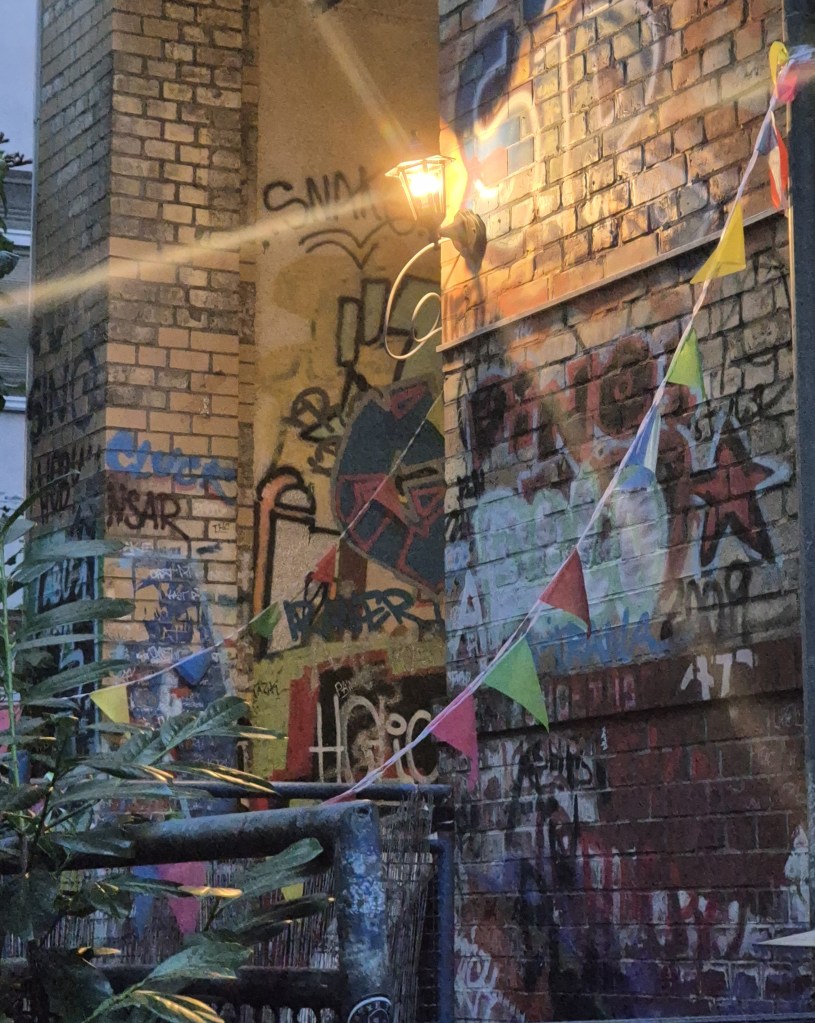
The predictable emptiness of streets on Sundays, for instance, reveals a linear rhythm; Germany’s Ladenschlussgesetz (the law requiring shops to close on Sundays) points to the country’s historic relationship to Christianity, and, in more recent centuries, trade unions. The social life on Sundays is much different to that in Amsterdam, where I was used to buying groceries and planning for the following week in a café. Instead, Sundays have become the day of cycling through empty streets to volunteer at community gardens, swimming in lakes with friends, and attending local Küfa evenings to meet new people and eat good food (Küfas, meaning kitchens for all, are social-political events that run regularly across Kreuzberg and beyond).
Cyclical rhythms present themselves in seasonal shifts, and as September rolled around I became aware just how much summer impacts spatial (and consequently social) organisation. As if waking from a long nap, neighbourhood spaces seemed to stretch and yawn, opening community centre doors for weekly events, advertising Rat & Tat (help & advice) evenings for upcoming months, extending or shifting opening times to accommodate the back-to-school, back-to-life changes post-summer.
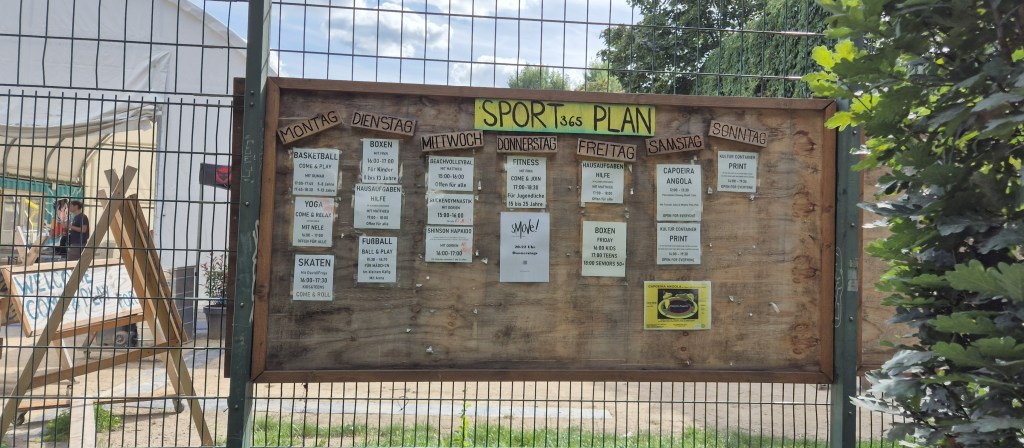
The same week I got an email back from a space I’d been hoping to volunteer (but that had been closed over the summer), I noticed a change in public outdoor spaces. Görlitzer Park, a large green space between the Landwehrkanal and the Spree, has hosted a ‘Sport 365 community’ since 20212, which offers members of the public a free space to get involved daily with sports activities. Even the areas of dry grass and bike parking outside the fenced space were busy over the summer, people laughing together after an afternoon sweating on the court, or groups waiting for a late-comer by the entrance, dressed for a few hours of something involving knee pads and helmets. Walking home from a (recently restarted!) knitting circle at a community centre one afternoon, I passed by the Görli sports park. There were the sounds of tennis balls hitting rackets, and the shouts of a team playing somewhere out of sight, but the energy of the space had changed drastically; I recorded a little voice note musing that it felt as though these were the serious sports-goers, the ones who’d persisted into September.
Lefebvre highlights the importance of thinking with the body to understand rhythm, to pay attention to the embodied and felt sensations and what they reveal about rhythmic activity. As I reflect on the seasonal shifts that point to broader cyclical and linear rhythms within Kreuzberg, it is the sounds in the background of my voice notes that remind me of the feeling of change, sometimes more so than the content of what I recorded. At the same time, I feel the seasonal changes even now in this train carriage; the cool air flow above me elicits goosebumps on my arms, and rather than feeling pleasantly cooled as I might in summer, I put on my jumper.
Coming back to Berlin as orange-brown leaves whoosh past the train window also signifies a shift in my approach to the field as I move into the next phase of my research. With ethnographic interviews ahead of me, the field feels tantalisingly rich and full of potential, and I wonder what rhythms are waiting to be uncovered.
References:
1 Lefebvre, H. (2004). Rhythmanalysis: Space, Time and Everyday Life (S. Elden & G. Moore, Trans.). Contiuum.
 Rhythms of Love